
Help Guide: Choosing the Right Industrial Vacuum Cleaner For Your Food Factory.
In food manufacturing, vacuum cleaners can play a vital role in maintaining hygiene standards, protecting operator safety, supporting regulatory compliance, and improving operational efficiency.
With different applications, dust hazards, usage levels, power supplies, and machine features to consider, choosing the right model can quickly become complex.
This guide explains the key factors that influence vacuum cleaner selection, helping you to identify the most suitable solution for your food production environment.

Choosing the Right Vacuum Cleaner Based on Your Application

Multi-Use (Wet and Dry)

Combustible Dust
(ATEX and ACD)
Multi-use (Wet and Dry) Vacuum Cleaners are suited to general applications that have little to no combustible dust risk. Capable of both wet and dry pick-up, they are the ideal choice for routine cleaning tasks that involve a mix of debris types.
Combustible Dust (ATEX and ACD) Vacuums are engineered for environments where combustible dust presents an explosion risk, such as flour and feed mills, confectionery production, pet food manufacturing, protein powder manufacturing, and bakeries.

Airborne Dust
(Dust Extraction)

Liquids and Water
Dust Extraction Vacuum Cleaners are built to capture suspended dust and eliminate it at source, before it has the chance to spread. These vacuums are best suited to silo and hopper emptying, packing and bagging lines, industrial mixers, and conveyor belts.
Liquid and Water Vacuum Cleaners are designed for removing large volumes of liquid quickly and efficiently. They are frequently used in washdown areas, as well as environments where standing liquids need to be cleared to maintain safe, hygienic working conditions.
Choosing the Right Vacuum Cleaner Based on Your Certification Level
Classification | Definition | Typical Example | Certification Required |
Zone 21 | Combustible dust likely to occur occasionally during normal operation, as an explosive cloud. | Areas close to dust filling/emptying points, near mixers, or around powder transfer points. | ATEX-21 |
Zone 22 | Combustible dust not likely to occur during normal operation, but if it does, will only persist for a short period. | General factory floor areas near, but not directly at, dust-handling equipment. | ATEX-21 or ATEX-22 |
Unclassified Area (Combustible dust is present) | Not a formally classified ATEX zone, but combustible dust is still present in the environment. | General production areas where dust is generated but doesn't meet zone classification criteria. | ACD (Appliance for Combustible Dust) |
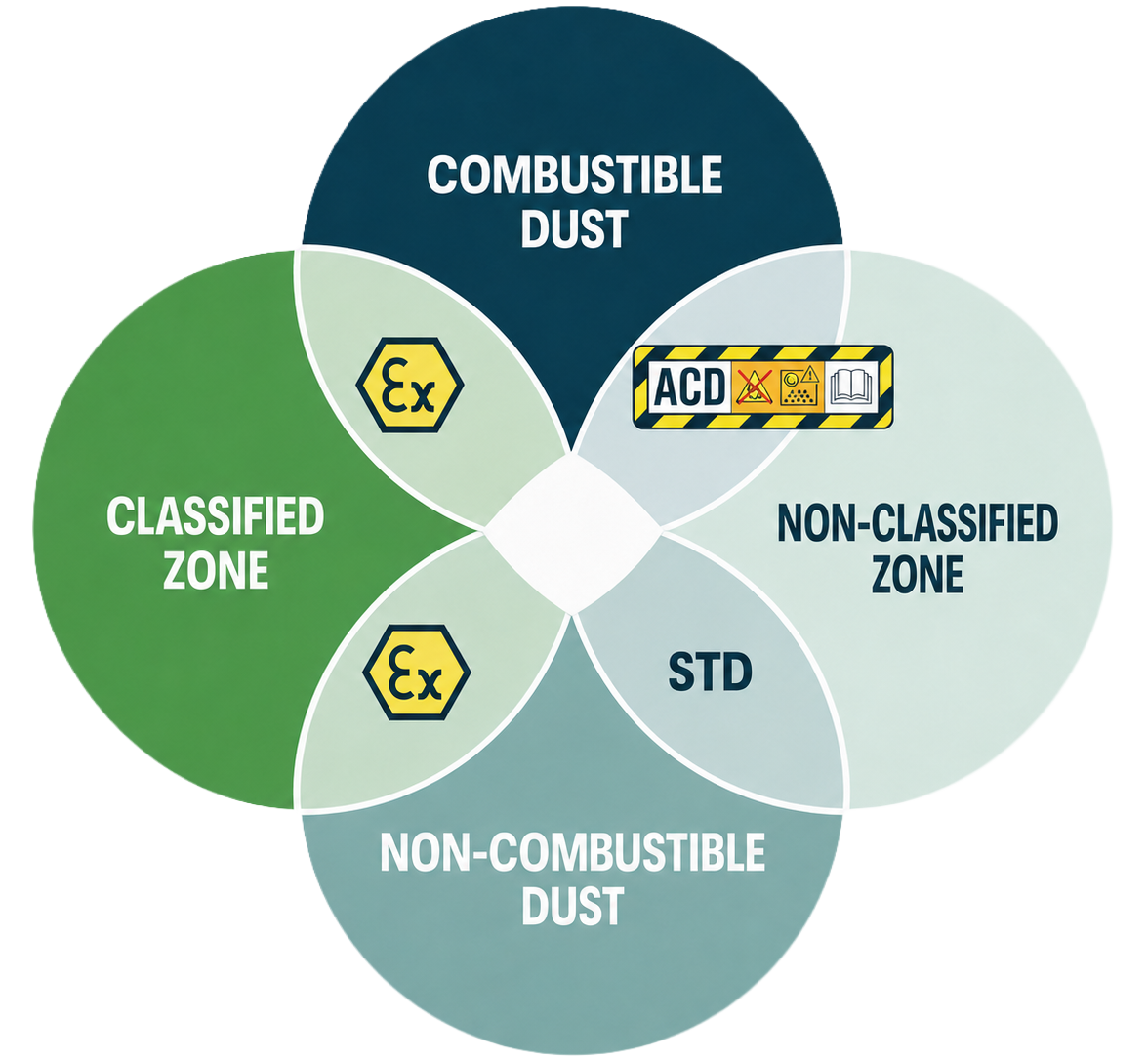
What is the difference between ATEX and ACD?
ATEX is a legally mandated for classified zones (20/21/22), rigorously tested and certified to EU/UK explosive atmosphere directives.
ACD is a step below ATEX, suited to unclassified areas where combustible dust exists but formal zoning hasn’t been applied.
It’s important to note that the two categories aren’t interchangeable, and doing so would likely be a compliance and safety breach. If a site has any formally classified zones, that dictates ATEX as the requirement; ACD only becomes an appropriate option outside those zones.
Choosing the Right Vacuum Cleaner Based on Your Usage Level
Light (> 5 hours per day)
Many sites require industrial vacuum cleaners suited to low-intensity use, where mobility, simplicity, and ease of handling are the priority.
Smaller vacuums are well suited to cleaning machinery, production areas, and confined spaces where access may be limited. Being more lightweight, they’re also easier to transport between different zones.
Capacity options for light usage typically range between 20 and 50 litres. For liquid removal, however, we’d recommend a vacuum cleaner with a capacity of 75 litres.

Key Features
- Motor Type: Brushed Motors (Non-ATEX applications), Brushless Motors (ATEX applications).
- Filter Cleaning System: Manual Filter Cleaning in most cases, some units have semi-automatic.
- Capacity: 20-50ltrs (75ltr in the case of liquid cleaning).
Frequent (5-12 hours per day)
If your vacuum needs to support frequent use, it’s recommended that you select a model with a capacity of 75 litres.
Alternatively, if you intend to use the vacuum for liquid applications then you will need to select a vacuum with a capacity of 100 litres.
It’s important that your vacuum cleaner has a removable bin, as static designs are better suited to light usage.

Key Features
- Motor Type: Mostly all Turbine. If the model has a brushed motors, it will have 3x motors for increased durability and power.
- Filter Cleaning System: Semi-Automatic.
- Capacity: 75ltr (100ltr in liquid removal).
Continuous (12+ hours per day)
Vacuum cleaners suitable for continuous use will typically have either have a capacity of 100 litres or a continuous bag system.
A continuous bag system is a dust collection method that allows the vacuum to keep running without stopping for bag changes. As one section fills, it’s sealed off and separated, while a new section is already in place ready to collect more material. This design feature minimises downtime and supports efficient, hygienic waste handling.

Key Features
Motor Type: Turbine Motor.
Filter Cleaning System: Automatic.
Capacity: 100ltr.
Choosing the Right Vacuum Cleaner Based on Your Power Requirement

110V – Industrial Plug
110V – Industrial Plugs support vacuum cleaners that are intended for light and frequent usage.

230V – UK Standard (Type G) Plug
230V – UK Standard (Type G) Plugs support vacuum cleaners that are intended for light, frequent, and continuous usage.

230V – Industrial Plug
230V – Industrial Plugs support vacuum cleaners that are intended for light, frequent, and continuous usage.

400V (3 Phase) – Industrial Plug
400V (3 Phase) – Industrial Plugs support vacuum cleaners that are intended for frequent and continuous usage.
Vacuum Attachment Kits


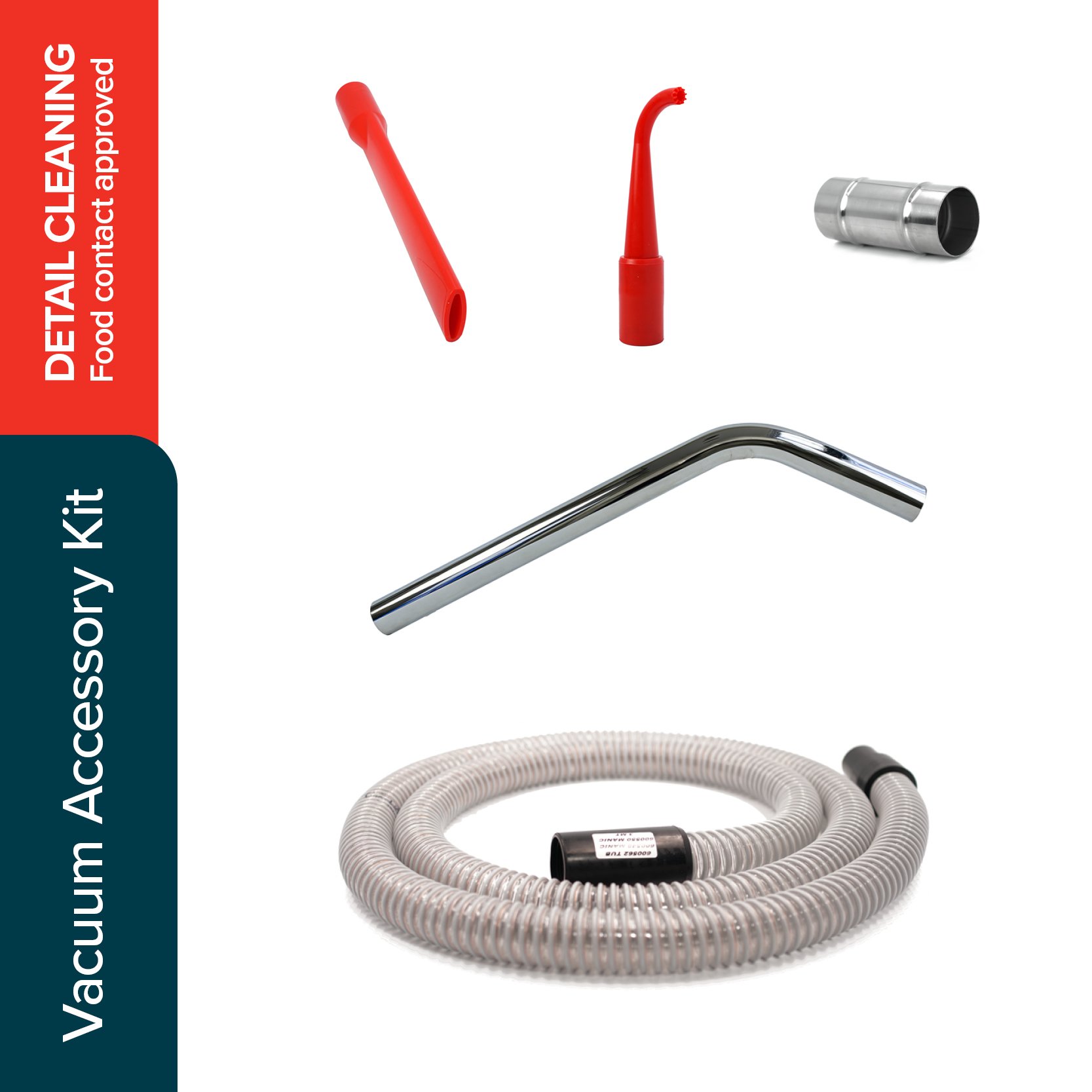
Vacuum accessory kits bring together attachments and accessories for easy set up.
Within the Klipspringer range, food contact approved kits are available in up to four colours, alongside ATEX-suitable kits in black for the extraction of combustible dust. Kits are available for a range of applications, including:
Simple 3-Step Process
There is a simple 3-step process for selecting and receiving a quote for your industrial vacuum cleaner. First, you select the unit, then you choose a compatible attachment kit, and finally you consider the additional accessories, whether that’s some of our more unusual attachments or a dedicated shadow board for storing your equipment.
If at any stage in this process you have questions about the options available, you can contact our in-house team on 01473461800 or sales@klipspringer.com. You can also complete the contact form at the bottom of this page.

1. Vacuum Unit
2. Attachment Kits

3. Accessories
The best industrial vacuum cleaner is one that matches the specific demands of your facility.
By considering your application, combustible dust risk, certification requirements, usage intensity, available power supply, and the features that will deliver the greatest operational benefit, you can invest in equipment that provides reliable, long-term performance.
For any questions about the Klipspringer range of Industrial Vacuum Cleaners and Accessory Kits, contact us on 01473461800 or sales@klipspringer.com. Alternatively, you can fill out the contact form below and we will be in touch.
If you would like to learn more about the industrial vacuum cleaners mentioned throughout this article, share your contact details below.


 Shadow Boards & Equipment Storage
 Visual Management
 Hygiene & Production Equipment
 Food Handling & Storage Containers
 Instrumentation and Monitoring
 Calibration & Service
 Segregation & Washdown Covers
 Detectable Equipment
 Specialist PPE
 Stainless Steel Equipment
 Hygiene Squeegees
 Vacuum Cleaners
 Food Manufacturing
 Food Storage, Distribution & Retail
 Auditors & Food Safety Inspectors
 Food Service & Hospitality