
How do you know if an ELISA test is suitable for the products you manufacture?
When it comes to allergen testing, obtaining accurate results is essential for food manufacturers. However, heat, pressure and other processing conditions can change the structure of allergen proteins, making them more difficult to extract and detect.
This can present a challenge for laboratories using ELISA tests to analyse processed foods. Even when an allergen is present in a sample, changes to the protein may affect how effectively it is extracted or recognised by the antibodies used in the test.
In this article, we explore how food processing affects allergen proteins, why some ELISA tests may underestimate their presence, and how Morinaga ELISA Tests address these challenges.
How Does an ELISA Test Work?
An ELISA (enzyme-linked immunosorbent assay) uses antibodies to detect specific proteins in a food sample, such as casein from milk or ovalbumin from egg.
Most ELISA tests use a sandwich format. One antibody captures the target protein from the sample extract, while a second antibody binds to another site on the protein. An enzyme then produces a colour change, which is measured to estimate the amount of allergen present.
However, antibodies do not recognise an entire protein. Instead, they bind to small, specific regions of its structure, known as epitopes. There are two main types to consider:
- Conformational epitopes: These are formed by amino acids that come together when a protein folds into its natural three-dimensional shape.
- Linear epitopes: These consist of a continuous sequence of amino acids that may remain recognisable even when the protein loses its natural shape.
This distinction is vital when testing processed foods. Heat and other processing conditions can change a protein’s structure, potentially affecting whether an antibody can recognise its target.
Understanding how these changes affect antibody recognition helps explain why some ELISA tests may be better suited to detecting allergens in certain processed food products than others.
How Does Food Processing Affect Allergen Proteins?
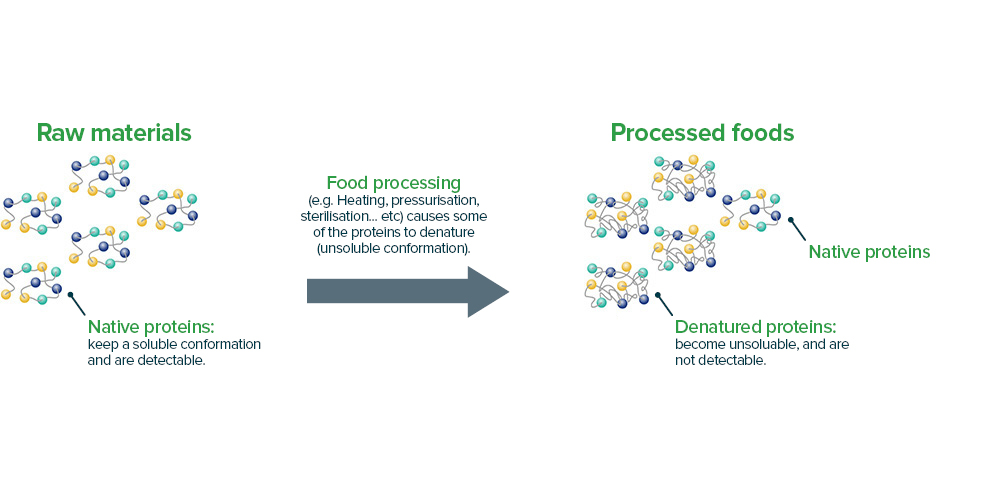
Food processing can change the structure of allergen proteins, affecting how easily they can be detected by ELISA tests. The extent of these changes depends on the ingredients, processing conditions and the type of food being tested.
Several changes can occur during processing:

Denaturation
Heat from baking, roasting, frying or retorting can cause proteins to lose their natural three-dimensional structure. High pressure and changes in pH can also cause denaturation.

Aggregation
Unfolded proteins can bind together, forming larger structures that may affect how they are extracted and detected.

Reactions with other ingredients
During heating, proteins can react with sugars through the Maillard reaction. They can also interact with fats and other food components.

Protein breakdown
Processes such as hydrolysis and fermentation can break proteins down into smaller fragments.
As a result, processed foods can contain a mixture of intact, denatured, aggregated and partially broken-down allergen proteins. Two products containing the same amount of milk, for example, may therefore behave differently during testing, depending on how they have been processed.
Importantly, these changes do not necessarily make a food safe for someone with an allergy. Allergen proteins can remain capable of triggering reactions after processing, making it important to understand how changes to their structure may affect their detection.
Why Do Some ELISA Tests Miss Denatured Proteins?
Changes to allergen proteins during food processing can affect ELISA results in two important ways. The protein may not be fully extracted from the food, or the antibodies used in the test may no longer recognise it.

The challenge of extracting the protein
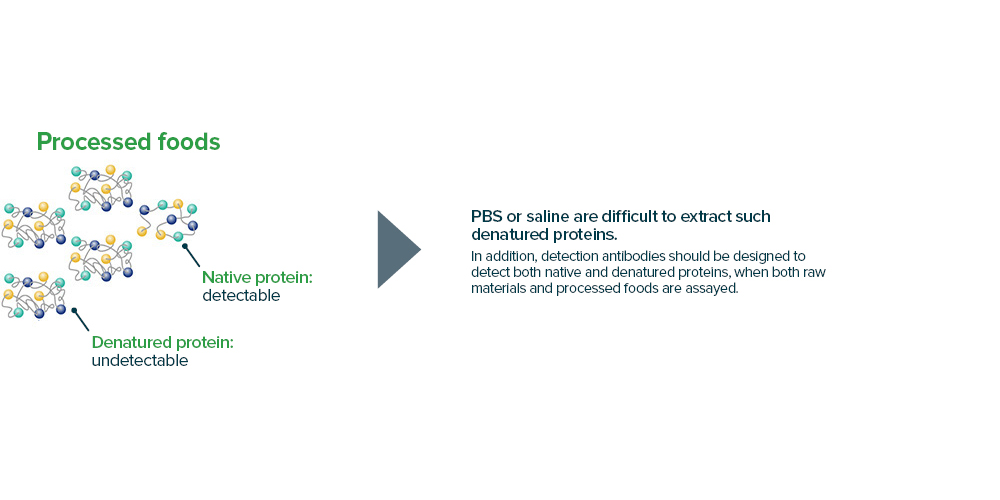
Before an ELISA test can detect an allergen, the protein must be extracted from the food sample into a liquid. Standard extraction buffers may work well with some proteins, but denatured or aggregated proteins can be more difficult to extract. They may become less soluble or remain trapped within the food matrix, alongside fats, starches and other proteins.
If the extraction process does not release these proteins into the liquid, they will not be available for measurement. This can lead to lower results, even when the antibodies used in the ELISA test can recognise the target protein.
When antibodies can no longer recognise the protein
Even when an allergen protein is successfully extracted, processing can affect whether the antibodies in an ELISA test can detect it. If an antibody recognises a conformational epitope, denaturation can change the protein’s shape and alter the specific region the antibody binds to. The protein may still be present in the sample, but the antibody may no longer recognise it effectively.
Antibodies that recognise linear epitopes may be less affected by changes in protein structure. However, aggregation and reactions with other ingredients can also make these regions less accessible or chemically alter them, potentially affecting detection.
Why testing unprocessed samples may not be enough
An ELISA test may perform well when used with raw ingredients but produce lower results when the same allergen is present in a baked, cooked or otherwise processed food. Testing an unprocessed sample or adding an allergen to a food after processing, does not necessarily show how effectively the method detects proteins that have undergone processing. The extraction procedure, food matrix and antibodies used can all influence the final result.
This is why it is important to evaluate ELISA test performance using the types of processed foods for which the test will be used. Results obtained under one set of conditions should not automatically be assumed to apply to another.
How Does Under-Detection Put Your Food Production Site at Risk?
When an ELISA test cannot fully extract or recognise a processed allergen protein, it may underestimate the amount present or fail to detect it altogether. This can have important implications for food manufacturers, particularly when demonstrating effective allergen control.

False-negative results
A food containing an allergen may produce a negative result if the protein is not detected. This can affect decisions about product labelling and allergen control, potentially allowing an issue to go unnoticed.

Ineffective cleaning validation
Allergen residues can remain on processing equipment after cooking or baking. If processing has changed the structure of these proteins, an ELISA test may not detect them as effectively, potentially giving a misleading indication of cleaning effectiveness.

Inconsistent results between batches
Differences in recipes, processing conditions and food matrices can affect how well allergen proteins are extracted and detected. Results may vary even when actual allergen levels are similar, making it more difficult to compare batches or suppliers reliably.

Non-conformances and failed audits
Reliable allergen testing helps demonstrate that your site’s allergen control procedures are effective. If ELISA test results underestimate allergen residues or are difficult to interpret, it can be harder to provide clear evidence that appropriate controls are in place.
How Do Morinaga ELISA Tests Address These Challenges?
Processing can make allergen proteins more difficult to extract and detect. For laboratories testing processed foods, it is important to use an ELISA test that can address both challenges.
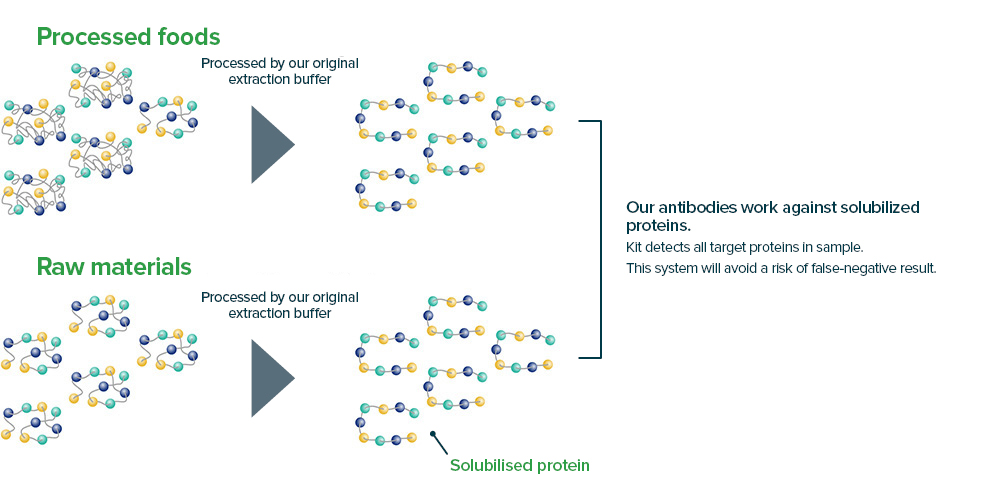
Morinaga BioScience’s ELISA Tests are designed to detect target proteins in both raw ingredients and processed food products, using an optimised extraction solution and antibodies designed to recognise the target protein.
An optimised extraction process
Heat, pressure and other processing conditions can change the structure of allergen proteins, causing some to become less soluble. Conventional extraction solutions, such as phosphate-buffered saline (PBS) or saline, may not extract these proteins effectively.
Morinaga ELISA Tests use an original extraction solution designed to solubilise the target protein, including forms that have become less soluble during processing. This helps make the protein available for detection during the ELISA procedure.
The extraction solution and procedure are consistent across the range, allowing laboratories to follow a common extraction workflow when testing for different allergens.
Antibodies designed to recognise the target protein
Effective extraction is only part of the process. The antibodies used in an ELISA test must also be able to recognise the target protein once it has been extracted.
Morinaga ELISA Tests use antibodies designed to recognise target proteins following extraction, including those whose structures may have been altered by processing. This helps support the detection of allergens in both raw ingredients and processed foods, reducing the risk of false-negative results.
The tests also use polyclonal capture antibodies, which recognise multiple sites on the target protein. This provides several potential binding sites rather than relying on a single epitope that may be affected by processing.
Some test kit manufacturers have taken special measures to ensure reliable allergen detection in both unprocessed foods and complex, highly processed foods. For example, the test kits from Morinaga BioScience are significantly better suited for processed food. In a number of studies it was shown that these tests are capable of detecting allergens in processed foods (e.g. baked cookies) whereas other ELISA tests show a much lower recovery rate.
Dr Sandra Kerbach, Eurofins Analytik GmbH, a leading food testing laboratory
To find out more about Morinaga ELISA Tests and how they could support your allergen testing requirements, contact the Klipspringer team on 01473 378 517 or email sales@klipspringer.com. Alternatively, use the contact form below.
If you would like to discuss a trial, share your details below…

About the Author
Libby Loughnan is Content Manager at Klipspringer, specialising in food safety and compliance. She writes extensively on hygiene monitoring and allergen management, covering everything from cleaning validation and false negatives to choosing the right testing method for your site.


 Shadow Boards & Equipment Storage
 Visual Management
 Hygiene & Production Equipment
 Food Handling & Storage Containers
 Instrumentation and Monitoring
 Calibration & Service
 Segregation & Washdown Covers
 Detectable Equipment
 Specialist PPE
 Stainless Steel Equipment
 Hygiene Squeegees
 Vacuum Cleaners
 Food Manufacturing
 Food Storage, Distribution & Retail
 Auditors & Food Safety Inspectors
 Food Service & Hospitality