
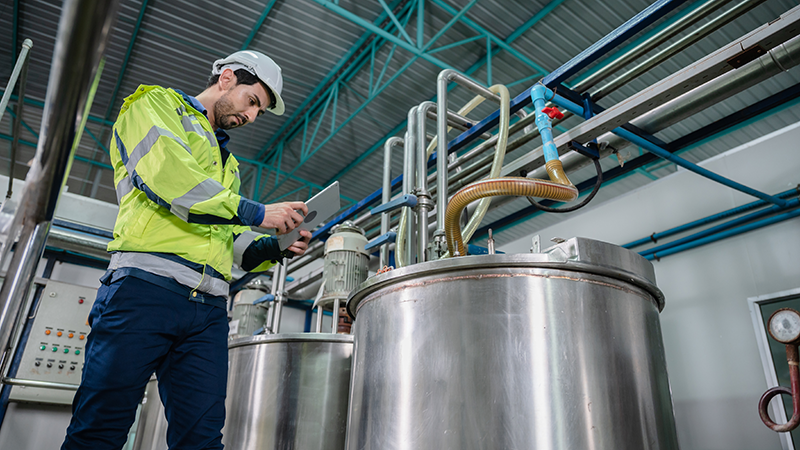
For engineering teams, moisture entering control panels, motors, and other critical components can lead to equipment failure, unplanned downtime, and costly repairs.
Water ingress is a common challenge in food manufacturing, particularly in areas where equipment is regularly exposed to high-pressure washdowns.
While hygiene teams are responsible for cleaning procedures, engineering teams play a key role in ensuring equipment is protected and can continue to operate reliably in wet environments.
This guide explores how to identify potential water ingress risks, assess the impact on equipment and production, and choose practical protection and segregation solutions. It also considers the engineering requirements for installing screens and curtains, helping you find an approach that works for your site.
Step 1: Run a Washdown Protection Audit
One of the most effective ways to identify potential water ingress points is to observe a washdown alongside a member of your hygiene team. This helps you understand where water is reaching equipment, which components are vulnerable, and where additional protection may be needed.
Work through the production line and record the potential ingress points, likely equipment failures, and suitable protection options.
Equipment | Common ingress points | Potential consequences | Protection to consider |
Control panels | Cable entries, door seals and gaps around buttons | Electrical faults, corrosion and unplanned downtime | Protective cover and a review of cable entry points |
Motors and gearboxes | Direct spray onto seals and terminal boxes, or water pooling underneath | Motor damage and bearing failure | Protective cover |
Emergency stops and push buttons | Water entering switch housings | Failed or unreliable switches | Protective cover |
Scale indicators and displays | Water reaching displays and electrical connections | Display failure and production disruption | Protective cover with a clear window |
Touchscreens | Direct spray and exposure to cleaning chemicals | Unresponsive or damaged screens | Protective cover with a clear window |
Sensors and connectors | Water entering cable connections | Intermittent faults and false alarms | Protective cover with a clear window or repositioned connections |
Not every area of a food factory carries the same level of risk. In some facilities, cleaning in place (CIP) systems mean that cleaning takes place primarily inside the equipment, reducing direct exposure to external washdown water.
Prioritise production lines and equipment that are regularly washed externally, particularly where sensitive electrical components are exposed to spray or moisture. This will help you focus protection measures where they are most likely to make a difference.
Step 2: Work Out the Cost of Failure
Understanding the potential cost of water ingress can help you build a stronger case for preventative measures. Maintenance logs and production records provide a useful starting point for assessing the financial impact of equipment failure and unplanned downtime.
A simple model can help estimate the annual cost: Annual cost = (F × H × C) + R
- F is the number of water-related failures per year.
- H is the average downtime in hours per failure.
- C is the cost per hour of lost production.
- R is the annual cost of repairs and replacements, including parts, labour, and call-out charges.
Review the last 12 months of maintenance records to identify water-related failures and estimate the cost of repairs, engineering time and lost production. Compare this with the cost of protecting vulnerable equipment to build a business case for preventative measures, using your own site data to support the investment.
Step 3: Specifying Your SegriCovers
Choosing the right SegriCover depends on the equipment you need to protect. Understanding the difference between standard and bespoke covers will help you identify the most suitable solution for your site.
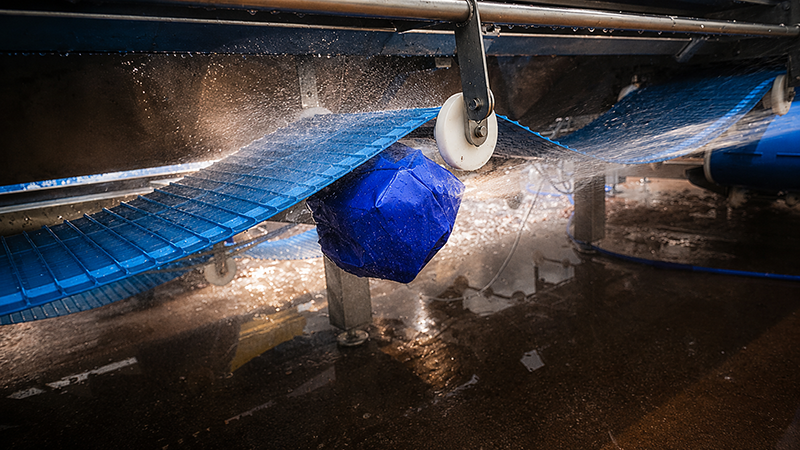
Standard SegriCovers
Standard SegriCovers are designed for common applications, including emergency stops, control panels and motors. They offer a straightforward option for protecting equipment without the need for a bespoke specification.
Our Standard SegriCovers are also available to trial, allowing your engineering and hygiene teams to assess seam quality, ease of use and overall suitability before committing to a wider rollout.
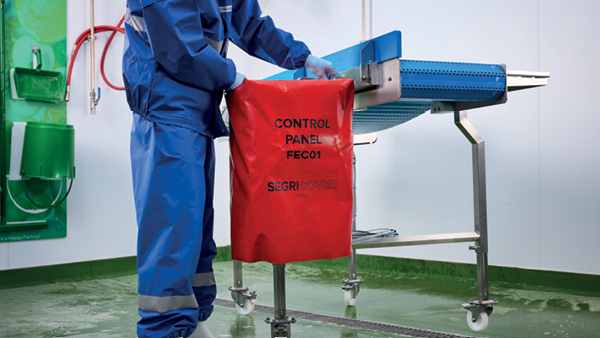
Bespoke SegriCovers
For larger equipment or components with unusual shapes, a bespoke cover may be more suitable. Providing accurate measurements and details of the equipment helps ensure the finished cover fits correctly, provides the required protection and allows essential controls to remain accessible.
When requesting a bespoke cover, provide your supplier with:
- Photos from several angles, ideally with a tape measure or ruler for scale.
- Width, height and depth, including handles, buttons, brackets and other protrusions.
- The position and direction of cable or pipe entries.
- Any requirements for touchscreen windows, access panels or control access.
- Information about heat build-up or ventilation requirements.
NOTE: If budgets require a phased approach, use your washdown audit and maintenance history to prioritise equipment according to risk, starting with components where water ingress could have the greatest impact.
Want to assess the quality for yourself?
Our Standard SegriCovers are available to trial, giving your engineering and hygiene teams the opportunity to assess seam quality, ease of use and overall suitability.
Get in touch with our team to arrange a trial, and we’ll send a cover directly to your site.
Step 4: Confirm Screens and Curtain Can Be Installed
Segregation screens and curtains can help prevent water ingress during washdown, but their suitability depends on the layout and conditions of your site. Confirming the installation requirements early can help avoid delays, unexpected costs and solutions that aren’t practical for your production environment. We recommend working through the following checks:
What to check | Why it matters |
Ceiling type and height | Suspended ceilings and high roofs can affect the mounting options and support required. |
Hanging points and fixings | Tracks and fixings must be suitable for the environment and withstand the demands of regular washdown. |
Airflow and extraction | Strong or constant airflow can cause curtains to move, affecting their position and effectiveness. |
Production line layout | Ensure there is sufficient space for curtains to hang and screens to be positioned without obstructing equipment or production activities. |
Overhead services | Pipework and other overhead equipment can affect curtain positioning and allow overspray to reach surrounding areas. |
Track cleaning and maintenance | Curtain tracks can collect dust and require routine cleaning. Consider whether a mobile screen would be easier to maintain. |
Screen height and stability | Taller screens need appropriate support and stability. Discuss the required dimensions and operating conditions with your supplier. |
Where a fixed curtain isn’t practical, a mobile segregation screen may provide a more flexible alternative. Mobile screens can be repositioned as production requirements change, without relying on permanent ceiling fixings or track systems.
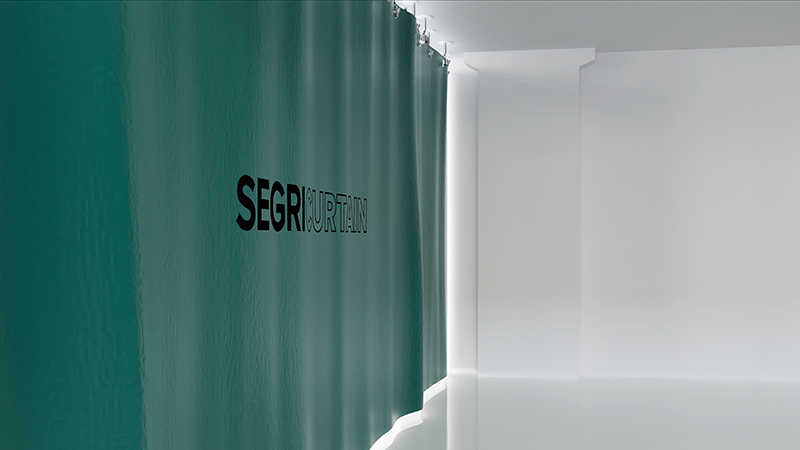
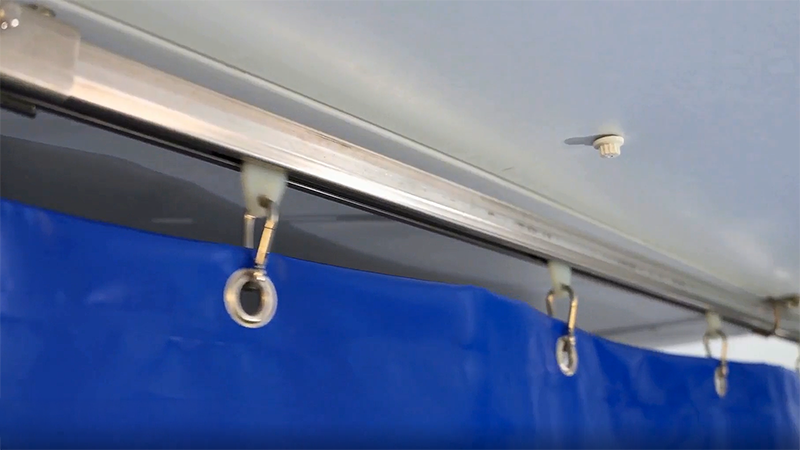
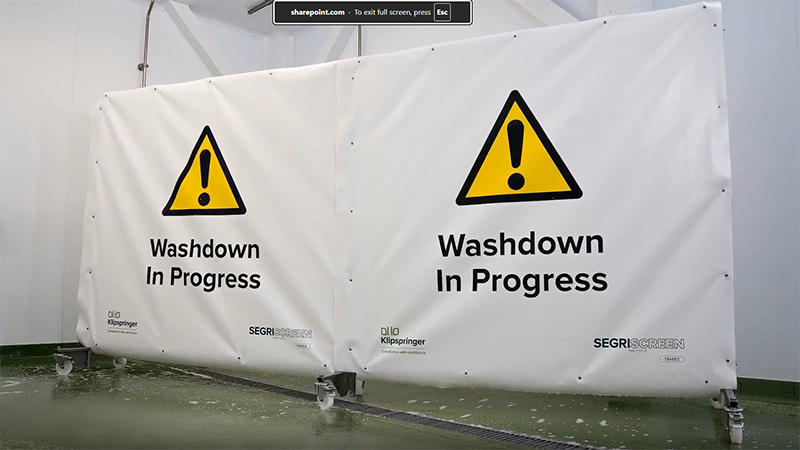
The key is for engineering to get involved before the solution is finalised. Reviewing the installation requirements alongside hygiene needs helps ensure the chosen screen or curtain is practical for your site and can be maintained effectively.
Step 5: Replace Improvised Maintenance Barriers
Maintenance work near active production lines can create challenges for both engineering and hygiene teams. Tarpaulins, temporary coverings and makeshift barriers are sometimes used to separate work areas from production, but these solutions can be difficult to clean, time-consuming to install and unsuitable for repeated use in wet environments.
Common issues with improvised barriers include:
- Hygiene and cleaning: Tarpaulins secured with string or hooks can be difficult to clean effectively and maintain in a hygienic condition.
- Production downtime: Stopping an entire production zone for a relatively small maintenance job can disrupt output unnecessarily.
- Durability and usability: Metal barriers without wheels can be difficult to position, while disposable covers may deteriorate or need frequent replacement.
Purpose-made segregation screens provide a more practical way to establish a defined barrier between maintenance and production areas. They can be positioned when needed, removed after the work is complete and incorporated into site cleaning and maintenance procedures.
Speak to your hygiene manager about the procedures already in place for maintenance near production. If teams rely on improvised solutions, keeping a suitable set of mobile screens available to engineering can help improve consistency, reduce setup time and support better segregation.
Make or Buy: Are In-House Screens Worth the Effort?
Building make-shift screens in-house may seem cost-effective, but material costs are only part of the equation. Engineering time, hygienic design, maintenance and replacement costs all need to be considered. Before building your own barriers, check:
- Material durability: Can materials withstand cleaning chemicals, water and washdown temperatures?
- Hygienic design: Are surfaces smooth and easy to clean, with no crevices or exposed fixings?
- Foreign-body risks: Could components rust, flake or break during use?
- Effective segregation: Will the barrier prevent spray passing through gaps? SegriScreens use overlapping fabric to help maintain coverage.
- Mobility and storage: Can screens be moved easily, cleaned and stored between uses?
- Documentation: Can you demonstrate that materials are suitable for the intended food production environment?
SegriScreens provide a purpose-made alternative, helping engineering teams establish temporary segregation without spending time fabricating and maintaining their own barriers. When comparing costs, consider labour, setup time and ongoing maintenance alongside the initial investment. A cheaper solution may cost more in the long run if it requires frequent repairs or replacement.
Step 6: Get Your Segri Project Signed Off

A clear risk assessment and cost case can help build support for your project, but getting the right people involved early is just as important.
- Work with hygiene. Combine your equipment failure history with the hygiene team’s cleaning requirements to demonstrate the risks and the benefits of protection.
- Confirm the budget process. Establish who needs to approve the investment, which budget it falls under and when funding is available. Prioritise by risk. Start with equipment where failures have the greatest impact.
- Consider trialling a standard SegriCover or assessing a SegriScreen before rolling out the solution across your site.
If you need help specifying a solution for your site, contact our team on 01473 461 800 or email sales@klipspringer.com.


 Shadow Boards & Equipment Storage
 Visual Management
 Hygiene & Production Equipment
 Food Handling & Storage Containers
 Instrumentation and Monitoring
 Calibration & Service
 Segregation & Washdown Covers
 Detectable Equipment
 Specialist PPE
 Stainless Steel Equipment
 Hygiene Squeegees
 Vacuum Cleaners
 Food Manufacturing
 Food Storage, Distribution & Retail
 Auditors & Food Safety Inspectors
 Food Service & Hospitality